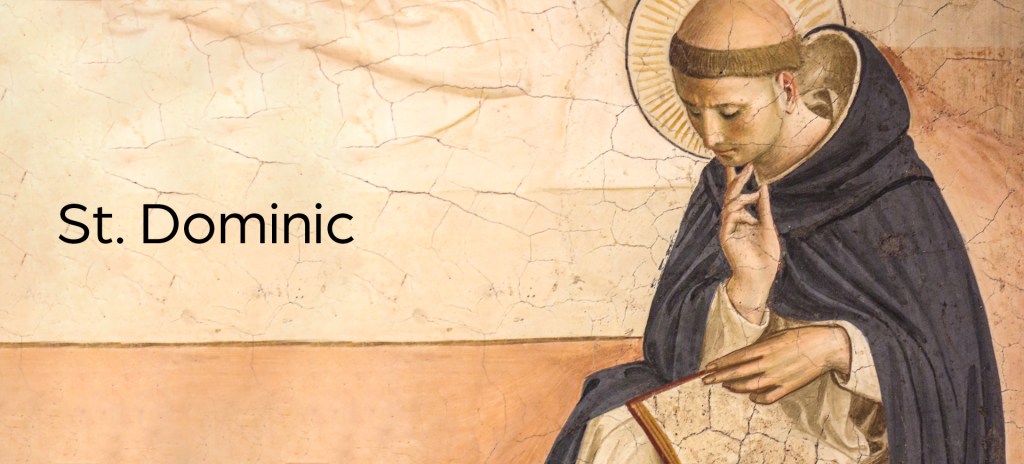
St. Dominic
Over 800 years ago in Medieval Europe, a man travelled the roads to preach the Truth, inspiring many others to join him. His name was Dominic Guzman.
Early Childhood
Dominic Guzman was born in 1173, in the town of Caleruega, central Castile, in the province of Burgos, Northern Spain. He was the third child of Felix Guzman and Jane d’Aza, who were wealthy landowners. Dominic had two older brothers, and understood from an early age that power and wealth brought duty and responsibility for others. His father employed the people of the town of Caleruega to care for his vineyards, tend his sheep and cows, and farm his lands. Dominic’s mother Jane was known for her kindness to the poor of the town, often secretly giving food and clothes to those in need. Dominic and his brothers, Anthony and Mannes, learned to read and write at home, as was the custom in medieval times.
Leaving Home
Life abruptly changed for Dominic when he was seven years old. His Uncle, Don Gonsalo, was a priest in a nearby town. He took Dominic to live with him, teaching him Maths, Latin, Music and Grammar. This path of study was geared towards a life in the church, rather than that of a knight, to which many young boys in Caleruega aspired.
By the time he was fourteen, Dominic had learned all his Uncle could teach him, and moved to Palencia to attend college. Here he studied theology and scripture. It is said that he memorized the Gospel of Matthew and often studied through the night. He loved learning and treasured his books.
One winter, when there was an outbreak of famine in Palencia, Dominic sold his books to buy food for the starving people, remarking “how could anyone study on dead skins (vellum) when people are dying of hunger?” Dominic may have left home when very young, but he was influenced by the generous spirit of his mother.
Priesthood
Having completed his studies in Palencia, Dominic was ordained a priest. The Bishop of Osma was impressed by the young man, and invited him to join his community of priests called Canons Regular. Dominic lived there for nine years, working with the poor and the sick, while continuing to spend his evenings in study and prayer.
A Life-changing Journey
In Medieval Europe, kings often sought the help of bishops for diplomatic negotiations. In 1203, the king of Castile, Alfonso VIII, asked Bishop Diego of Osma to lead a delegation to Denmark to arrange the marriage of the king’s son to a Danish princess. Bishop Diego invited Dominic to accompany him on the long, dangerous journey to Denmark.
While travelling through southern France on the way to Denmark, Diego and Dominic stopped overnight at an inn in Toulouse. The innkeeper belonged to a group called the Cathars, or Albigensians, who believed the visible material world, including the human body, was evil and corruptible. This stance demonized the human body and interpreted the death and resurrection of Christ as meaningless. Dominic spent the night listening to the innkeeper’s arguments, including his belief that the Catholic Church had become too worldly and removed from the people. By dawn, Dominic had convinced the innkeeper to return to the Catholic faith. The discussion raised Dominic’s awareness of the necessity for a Church to model what it preached, and of the urgency for educated preachers to counteract the heresy of the Cathars.
When Diego and Dominic had completed the marriage arrangements in Denmark, they travelled to Rome. They hoped to receive permission from the Pope to become missionaries. The Pope refused their request, but invited them to join the existing mission to preach the Gospel to the Cathars in France. Diego and Dominic agreed. Returning to the south of France in 1206, Diego and Dominic discovered that the three Cistercians had almost given up on their mission against the Cathars. The Cathars had become a very powerful group. Dominic, remembering his conversation with the innkeeper in Toulouse, explained that they would have to lead simple lives, so that the people would accept them as true followers of Jesus and return to the Catholic faith. Diego had to return to his diocese in Spain where he died unexpectedly, and the Cistercian mission later came to an end. Dominic was left alone in the south of France, preaching against the Cathars whenever and wherever he could.
Preaching: 1206 – 1221
In 1206 Dominic was living in the town of Fanjeaux, not far from Toulouse. Many Cathar families lived there. In the evenings, Dominic went to a quiet place to pray at the edge of the town. This quiet place overlooked the fields of wheat and the village of Prouille. One evening, while Dominic gazed over the lands below, he saw a globe of fire travel across the sky and stop over Prouille. This happened again the following two evenings. Dominic saw this as a sign from God. He decided that Prouille should become a centre for preaching the Gospel. This quiet place is called the “Seignadou” today.
Dominic continued his mission of preaching the Gospel of Truth in difficult circumstances. He walked everywhere, travelling the roads from Fanjeaux to Prouille, Toulouse and Carcassonne. He was always full of joy and reminded the people that they were made in the image of God, who loved them. One day, while travelling down the hill from Fanjeaux to Prouille, Dominic realised that his enemies were waiting to attack him. As he approached them, Dominic began to sing a hymn as loudly as he could. His enemies could not harm him because of his great belief in Jesus. A cross marks the spot today, the Cross of Sicaire.
During 1206, Dominic established a monastery in Prouille for some local women who had converted to the Catholic faith. Later it would also provide a place of rest for the Preachers as they travelled.
Dominic realised that he needed to form a group dedicated to preaching the Gospel and living a simple life, if he was going to succeed in his mission. The preachers would lead the people to God by the example of their lives. The Bishop of Toulouse invited Dominic to preach there, and soon he was joined by others and a community was formed. Study was necessary to become a good preacher, and Dominic sent his followers to theology classes. They wore white habits and black capes. In 1216, Pope Honorius III confirmed the Order of Preachers. Dominic was delighted. He wanted to set the world on fire with the love of God. His mother had told him that before he was born she had a dream of a black and white dog, carrying a blazing torch in its mouth. Now he and his followers would carry the flame of God’s love to all they met.
In 1217, Dominic divided his followers into pairs, and sent them off, two by two, to the university cities in France, Italy and Spain to preach and study. They were very successful and many young people joined them. Dominic continued to travel, sometimes walking 20 – 30 miles daily. He slept wherever he could find shelter, wrapped in his cloak. He travelled to Bologna and Rome, founding communities there.
Soon there were so many Preachers, that Dominic and some of his followers wrote some rules to help them live simple lives for God. In 1220 and 1221 important decisions were made. All preachers were to study, to become the best preachers that they could be. They were to live in community, sharing what they had with others. They were to pray and praise God with their lives. Communities were democratic, electing their leaders themselves. By 1221, Dominic was exhausted from constant travel. He became ill, and called his community together in Bologna and told them “do not weep for me, because I am going to a place where I can serve you better” Dominic died on August 6th 1221. He was 48 years old. Today, over 800 years later, the Order of Preachers founded by Dominic, continues to preach the Gospel of Truth.
 Lay Dominican's Ireland